An Open Letter to My Fellow Catholics Regarding the Scourge of Racism

An Open Letter to My Fellow Catholics Regarding the Scourge of Racism

This is the GoogleDoc I originally penned back in June, that was shared widely on Instagram, and then on Twitter.


1. I am a black cradle Catholic from several generations of Catholics. Organists, parish council members, composers, ushers, third order religious,  and altar servers. I am your family. I’ve experienced profound joy in my Church, and I’ve been very vocal about that. But today I’m going to be vocal about my pain. Far too often, bringing up my experiences of racism has been met with unreceptive attitudes of all species:

  •  “I’m colorblind”
  • “racism isn’t really still a problem”
  •  “you’re not like other black people…you’re articulate and non-threatening” 
  • “you’re probably imagining or exaggerating the nature of that interaction” 
  • “so-and-so isn’t actually racist, but well-meaning (as if someone can’t be both)” 
  • “why are you bringing up race when it makes everyone so uncomfortable? Don’t be so sensitive!” 
  • “can’t we all just be nice to each other and love Jesus because race is irrelevant? Trust in God and his mercy!” 

This stuff hurts. I don’t always dwell on it, because if I did, I wouldn’t get much done, and I’d be bitter and annoyed all the time. But it still hurts.

Also, because those statements have some truth to them, and because I don’t particularly enjoy unproductive and futile conversations, I shut up (which is probably, if inadvertently, what these responses are intended to do).  I eventually stop trying to share stories, but rather bury them deep where only Jesus and Mama Mary (and my saint friends!) can see them. It’s a silent burden that you bear, since you know that Jesus in the Eucharist is real… you feel like Peter when he says, “To whom else shall we go?” (John 6:68). And you want to have friends and be liked. But at times it feels like I have to sacrifice my blackness so that people will believe I’m authentically Catholic, or their brand of Catholic. I don’t like to be political, and I don’t like to speak to a wearied audience (former teacher here), but I am speaking out now because it feels like people are finally listening. Actually, they’re actively asking me to share my story. 

There are many correct responses to our current situation, so you’ll have to pray about that. I know some of you are freaking out about whether or not to post, make art, be silent, reach out, etc. I can’t really answer that for you, but I can offer a small suggestion. One thing you can do is to make an effort not to say any of the above things in a discussion about race, and pray for the Holy Spirit to open your heart and mind. If a BIPOC sister in Christ is opening up to you, she may very well feel terrified while doing so. She may be bracing herself for dismissive comments. Strive to honor her vulnerability. 

2. We know you know that racism is evil. What we’re unsure about is whether you believe it really exists, exists to the degree that people say it does, can spot it in yourself and others, and are willing to actively work against it.

3. As a fairly traditional Catholic, I don’t want to have to cite rogue Jesuits or questionably Catholic sources. I cringe at them, too. But many of my admired Trad priests are silent right now. Honestly, that is heartbreaking. It makes me feel emotionally and spiritually orphaned by those I’ve made an effort to revere as Father. I’ve experienced the deep love of Christ in the Eucharist, and God my Father, and at the end of the day, their love is more than enough. At the same time, it helps to know that those who stand in Persona Christi are able to recognize the realities I face and take action. That those who are often willing to “afflict the comfortable” over other matters of morality are willing to take a stand in this one, too.

I’m scared to include this bit, because I don’t want people to think that I don’t love my priests, because I do. But this is a pain point for me. Additionally, I know that a lot of sources that aren’t deemed credible by Trads are the ones making more noise about this, so I felt it might be necessary to play this card.

4. Speaking out against racism doesn’t automatically align you with any political party. It just means your eyes are open. Maybe it feels too snowflake-y or social justice-y. But…is it really?

5. I am not an expert on all of the statistics and research. At the same time, I want to say: before you dismiss racial profiling, systemic racism, or police brutality as a myth invented or exaggerated by the media, remember that while your first exposure to these stories usually comes from the media, a BIPOC’s first exposure to these incidients comes from their own lives, or the experiences of those in our families and communities. While very imperfectly, the media is not telling BIPOCs anything new.

Many different communities are rightfully suspicious of the media and their agenda, but please don’t let that stop you from missing the message. I’ve seen many posts on social media from Catholics that all of the “systemic racism stuff” is a myth. It makes my head and my heart hurt. If you have people in your communities that think this way, I implore you to courageously and charitably challenge them in this thinking. We can’t fight something that we don’t believe exists (you know, how people don’t think Satan is real, so he has that much more power?!?) 

6. Please consider that many people very near and dear to my heart have left the Church because of these matters, and it is very hard to convince them that it’s worth coming back. It will take a miracle to bring them back. No, people shouldn’t leave the Church because of insensitive actions, but not everyone is patient. Even God in his infinite mercy has a breaking point, and demands justice (I’m not a theologian– I trust you know what I mean). Souls are at stake. Your own soul is at stake. 

7. Learn about segregation in the Church. My own family faced it. Particularly, my grandparents actively campaigned against it. My grandmother, a mother of 15 children, was not made to feel welcome at the Catholic hospital. She had to tell them plainly, “I’m Catholic, so I want my kids to be born at the Catholic hospital.” She should not have had to say that. 

Her husband, my grandpa, had to work with local leaders to desegregate the Catholic school system, because as a Catholic, he wanted his kids to go to Catholic school. And even as a postal worker, chose to pay money to send his children to schools where they weren’t exactly wanted. He should not have had to do that.  I could go on. 

I don’t care that it was a different time and place. This is an unfortunate blemish (that’s being charitable) on the history of my Church.


Ok. I’m exhausted now. Whatever responses this will generate…I want to be there and respond to you, but it may take me some time. Please tread lightly. I’m trying to figure out how to balance people’s desire to know who is writing this with my desire for privacy and healthy boundaries. Figuring it out.

Thank you for reading this. It’s already a start. God bless you! 

Prayerfully yours in Christ,

Christina


The Proliferation of Petty

The Proliferation of Petty

Petty culture has been finding its way into my social media feeds for at least a year now. Memes, videos, and gifs of ex-girlfriends seeking revenge, or passive aggressive ways to reprimand one’s roommates generate thousands of likes and shares, some of them, admittedly my own. Have you ever received a disapproving email in which your boss was unnecessarily CC-ed? Didn’t you think “That was so petty and uncalled for” ? What’s with the recent trend of encouraging people to joke about antisocial and immature behavior?

It’s not truly a new phenomenon; pettiness has long been part of the human condition, and the English term has been in use since the 1600s. It’s no secret that our modern culture isn’t exactly a fertile garden of virtue, but the weed of pettiness seems to be rearing its ugly head in the cultural consciousness. 

Let’s call pettiness what it is: a vice. Like greed, pride, or laziness, we have to realize that this is not a good thing, right? Perhaps we can say that the father of pettiness is the “sorry not sorry” attitude. We are experts at turning behaviors that we should rightfully feel for into behaviors that we laugh at or celebrate. And this kind of shame that demands nothing short of mass approval to make itself feel okay. But pettiness isn’t okay. We can lie to ourselves or say, well, pettiness is not the same as full blown aggression or bullying. Indeed, the word petty stems from the French word “petite,” or small (out of all of the posh, French traits to exude, why pettiness?!) 

If a problem is small, shouldn’t we just be thankful for that, and move on? To be petty is to be small—to be small-minded and small-hearted. It’d be wrong to say that people have exalted pettiness as a virtue—that would make no sense. No, they’ve gone for the more subtle variant; they’ve turned pettiness into a joke, which is much more intellectually palatable. 

The culture loves to do this. When they can’t get away with calling something good, they just call it funny. Then it’s okay, right? It made someone laugh, so is it really all that harmful? Doesn’t laughter neutralize the toxic effects of a vice? Hopefully you see what I’m getting at. We have to be careful about what we trivialize, before it becomes something that undermines our character and our relationships. What we laugh at one moment can easily become our attitude the next. sarcasmsociety.com weighs in:


Pettiness As An Art Form

In this day and age of social media where we can post something online and get a dopamine spike watching all those likes come immediately pouring in, being the bigger person doesn’t have the same rewarding feeling that it used to. And in this day and age of social media, it’s become much easier (and a heck of a lot more fun) to just be the absolute definition of petty…

Credits: http://imgur.com

Yes, being petty is childish and not something that civilized adults should ever engage in.

But these days, thanks to the creativity and share-ability of the internet, pettiness has been elevated from an ugly characteristic to an absolute art form.

I know, I know, I must be a ton of fun at parties. I’m all for an occasional joke. If petty had simply stayed an occasional joke, I might still be laughing along. But the subtle way in which it is undermining maturity and emotional intelligence deserves a good discussion. 

Ladies (and gentlemen), let’s bring back magnanimity. It’s hard to say, and even harder to practice, but just imagine how many beautiful bridges we could build in this world if we chose to be generous, expansive souls. We could aggressively cut out the cancers of gossip and ingratitude, and replace them with words that build and encourage. 

We could give our loved ones the benefit of the doubt, or communicate hurts or concerns with directness and charity. We could overlook more faults than we correct. 

What do we get out of magnanimity? 

Respect. At the end of the day, someone may laugh at a petty person, but no one really respects them. They expose their reputations and relationships to ruin. 

Some of you may have read my suggestions on how to be a more magnanimous human being and thought, “But I’m not a pushover!”

Good! Nice is not a virtue!

If you have a serious problem with a co-worker, friend, roommate, or otherwise, please don’t let it fester.

The flip side of the petty coin is that righteous anger needs to be expressed righteously.

The regrettably few times I have done this well usually paid off—I respect myself more for not falling into the instant gratification of indulging my inner child, and the other person respects me for being willing to confront the situation with grace. 

At the end of the day, you shouldn’t practice any virtue simply for what you get out of it—after all, magnanimity is about giving! Still, it helps to reflect upon what you’re gaining and preserving when you choose to act bigger than you feel. Giving the gift of your trust, honest feedback, and acceptance of small faults will show those around you that you are trustworthy. The respect you’ll have for yourself is not a bad perk, either! So, how are you going to practice magnanimity today? 

Special to the Father: Downton Abbey’s Soul-Melting Portrayal of Spiritual Adoption

Special to the Father: Downton Abbey’s Soul-Melting Portrayal of Spiritual Adoption

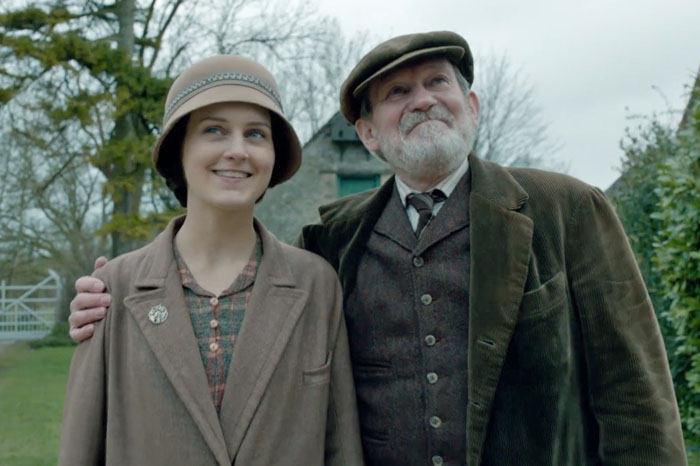
I apologize for the abhorrent quality of the video capture. But wow. Go ahead and grab a handkerchief. This goes down in my book as one of the most powerful scenes in all of Downton Abbey. But it’s a quiet sort of powerful, and easy to gloss over in the midst of the drama of the show’s more glamorous characters.

For those that are unfamiliar with this iconic series, let me give you some backdrop. Daisy is a kitchen maid in a grand, English estate. Even for a maid, she’s at the bottom of the totem pole; she’s not considered particularly well educated (though as the seasons go by, we get to see how smart and ambitious she is!), or well bred. She enters into a deathbed marriage with her close friend and footman William, who has just returned from serving in World War I. Their marriage lasts for less than 24 hours, and after his death, she is tormented with the sense that she only married him to oblige his dying wish, and that it was never a “real marriage.” Even before becoming a war widow, Daisy had a low opinion of herself. Though others recognized her marriage to William as a heroic act of love and affection, she fails to see any noble qualities within herself or that gesture, and falls deeper into self-loathing. She reluctantly keeps in contact with William’s father, Mr. Mason, and shortly after, the touching scene you just witnessed unfolds. Just watch Daisy’s face light up as the rays of love begin to warm her heart. She has an epiphany, and she’s finally able to see herself through the eyes of Love.

I, too, am guilty of shrinking from the supreme Love of the Father. The reality of my spiritual adoption perplexes and embarrasses me. I’m so undeserving! I haven’t earned it! Why choose me? I’m nothing special, nothing worth loving. But then the Father says to me “Let me take you into my Heart and make you special!” Isn’t being “special” at the heart of being loved? Out of all of ideas racing through the mind of God, He decided that you were a very good one (Genesis 1: 31). The Father continually beholds us in our uniqueness and finds us worthy of love inasmuch as He has deemed us worthy to receive the sacrifice of His only begotten Son.

Mr. Mason is really the driving force behind this beautiful relationship with Daisy. Daisy, in her emotionally immaturity and shame makes excuses to avoid going to his farm, or corresponding with him. Instead of being receptive to his love, she put up walls. She felt somehow that she never truly loved his son, and because of that, that she couldn’t really claim him as a Father-in-law. Are we not the same? Yet the Heavenly Father sees the little love we pour out open his Son, and even if our motives aren’t perfect, receives it with great joy.

Perhaps William not only knew that his dad needed someone to continue to be a spiritual father to, but that Daisy, having never received love from her biological parents, needed to be pursued by a tender, fatherly heart.  To love as a Father is not merely what God does–it’s who He is! Beautiful one, may you let the Father take you into his heart and make you special today and always.